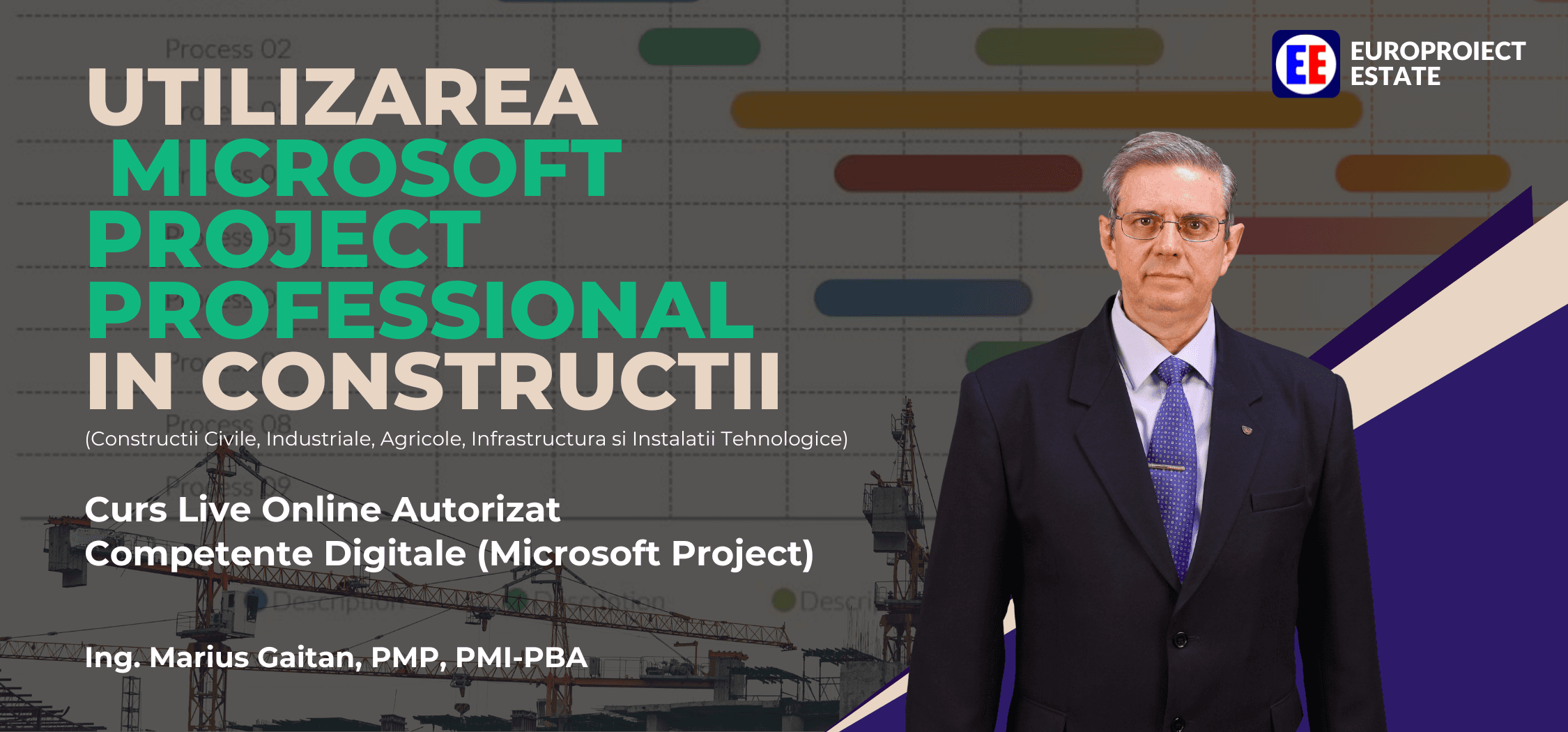
Utilizarea Microsoft Project în Construcții
Period
17 - 18 October 2026
Schedule
09:30 - 13:30
Format
Online Live
What competencies you will demonstrate
By the end of the programme, you can demonstrate concrete competencies applicable on real projects.
Labs
Participants on this course get access to the Europroiect Estate Labs platform. There you work through hands-on labs on the course scenarios, across three difficulty levels. It is not a video catalogue. It is guided practice: you finish a live session, then apply it in the lab.
Why Microsoft Project has become a mandatory competence in construction
In construction, a schedule is no longer just a representation of dates. It is the temporal and operational model of the project. Hundreds or thousands of activities, dependencies, resources, costs and constraints must be correlated and updated continuously. Microsoft Project turns the WBS into a calculable programme: you identify the Critical Path, assign resources, set costs and analyse the effect of changes on the finish date.
The programme must be calculable, not merely drawn
Activities are linked through FS, SS, FF and SF, Lead/Lag and constraints. A change produces effects across the entire programme; it does not remain a static bar on the Gantt.
The Critical Path must be identified and controlled
You know which activities determine the finish date and where float exists. Microsoft Project calculates the Critical Path and shows what can move the project deadline.
Resources must be integrated into the programme
Labour, plant, materials and costs are defined, assigned and analysed over time. The course treats Work, Material and Cost resources as distinct types.
Overallocations must be anticipated
Resource Usage, Resource Graph and resource levelling surface unrealistic loading before it reaches site.
Time and cost are analysed together
Scheduling, resources, rates, budgets and Cash Flow move from an aesthetic Gantt to an integrated model of execution.
Decisions are tested before they are applied
You change durations, resources, dependencies or availability and see the What-If scenarios before you take the decision in the field.
Using Microsoft Project professionally does not mean knowing how to draw a Gantt. It means building a dynamic model of the project, in which the WBS, activities, durations, dependencies, resources and costs form a single system. The real competence: turning project data into information for decision.
Impact & Metrics
Decision-ready benchmarks from global reports.
Projects: success vs failure
How success is measured (measurement trifecta)
Average project performance rate
73.8%
Average across respondents
Construction delivery: schedule & cost overruns
In construction and infrastructure delivery, plan vs execution (schedule & cost) leads to significant variance — which is why baselines and integrated control matter.
Schedule overrun
35%
Overall avg: ~12%
Cost overrun
59%
Overall avg: ~28%
Trainer
Who delivers this programme

Ing. Marius Gaitan, PMP, PMI-PBA
CEO & President of Europroiect Estate
Ing. Marius Găitan, PMP, PMI-PBA is one of Romania's most respected professionals in project management and business analysis, with over 35 years in business and more than 30 years leading enterprise-level construction projects.
Certified Project Management Professional (PMP®) and Professional in Business Analysis (PMI-PBA®), Marius is internationally recognised for his expertise and direct involvement in developing and improving the global standards of the Project Management Institute (PMI® - USA).
As founder of Europroiect Estate®, Marius Găitan has transformed the organisation into a leader in consulting, training and organisational development, training hundreds of professionals and contributing to modernising project management practice in Romania and internationally.
Through his courses, participants benefit from the expertise of a professional directly involved in writing and reviewing global PMI® standards, which guarantees up-to-date, internationally validated and practically applicable content.
Platform
Europroiect Estate Labs
Participants on this course get access to the Europroiect Estate Labs platform. There you work through hands-on labs on the course scenarios, across three difficulty levels. It is not a video catalogue. It is guided practice: you finish a live session, then apply it in the lab.
- Practical labs dedicated to the course you enrolled on
- Three levels: Easy (foundations), Medium (real project), Hard (decision under constraint)
- Progress at your own pace after live sessions, on the same platform
Easy
Foundations
You build the basics. You complete the right artefact with guidance: a clean WBS, a schedule, a register, a baseline file.
Medium
Project
You assemble the pieces on a project scenario. Dependencies, constraints and real data appear. This is where you see whether you can apply, not just reproduce.
Hard
Decision
A decision with incomplete data, conflict or deviation. You must analyse, choose and document.
Labs access is included for participants on this Live Online course.
What competencies you will demonstrate
By the end of the programme, you can demonstrate concrete competencies applicable on real projects.
Professional project setup
You set parameters, calendars, scheduling options, templates and the working environment in Microsoft Project.
Building the WBS of a construction project
You organise the works by phases, levels and activities and use the fields required to structure the programme.
Developing the execution programme
You define activities, durations, milestones, constraints and deadlines for a realistic programme.
Logic of execution and the Critical Path
You use FS, SS, FF and SF dependencies, Lead/Lag, and identify the activities that determine project duration.
Resource planning
You define Work, Material and Cost resources, calendars, availability and cost rates.
Resource assignment and control
You assign resources, analyse loading, identify overallocations and use Task Usage, Resource Usage and Resource Graph.
Costs and budgets
You integrate costs with activities and resources, use budgeted resources and analyse project cost.
Optimising duration, resources and costs
You work with the work formula, Task Type, Effort Driven, levelling and adjustments towards a feasible solution.
Complex projects and reporting
You consolidate multiple projects, manage dependencies and shared resources, and report including Cash Flow.
Microsoft Project as a decision instrument
You build a dynamic model: you test scenarios, customise information, report and use visual tools, including Kanban.
Who this programme is for
The programme is for professionals who must turn project information into a structured, calculable and controllable execution programme. It is not merely a course of buttons, but of planning, CPM, resources, costs, optimisation and reporting.
A good fit if…
- ·Project managers who develop, analyse and control construction project programmes
- ·Civil engineers and site managers who plan the sequence of works, durations, dependencies and resources
- ·Planners / Planning Engineers who develop and update execution programmes and analyse the Critical Path
- ·Project Control Managers and Project Control Engineers who track time, resources, costs and performance as an integrated whole
- ·Cost and resource leads who correlate activities with labour, plant, materials, rates and budgets
- ·Contract managers and contract administration specialists, for whom the programme tracks contractual dates
- ·Contractors and subcontractors who plan their works, resources and activity sequence
- ·Consultants, site inspectors and members of management teams who critically analyse a programme received from the contractor
- ·Professionals who manage several projects at once, including shared resources
- ·Construction specialists who want to move from an elementary Gantt to professional planning (WBS, network, CPM, resources, costs)
In essence, the programme is for the professional who does not want merely to produce a chart, but to build a real model of the project: you plan, analyse, optimise and control execution.
The practical path of the 4 sessions
At the end you do not merely know Microsoft Project. You complete a full process: you build the structure, develop the programme, optimise resources and costs, then use the information for control and reporting.
- 1
You build
Setup · Calendars · WBS · Gantt
- 2
You plan
Activities · Durations · Dependencies · CPM
- 3
You optimise
Resources · Assignments · Costs · Levelling
- 4
You control
Multiproject · Cash Flow · Reports · Kanban
Session-by-session programme
Each session has clear objectives: what you learn and what you apply.
117 October 2026
Microsoft Project setup and project structuring
Details
17 October 2026
Microsoft Project setup and project structuring
Build the working foundation: application and project configuration, calendars, views, tables, customisation and turning the structure into a usable WBS.
What you learn
- Configuring the Microsoft Project environment: general options, Schedule, Display, Save, Advanced
- Project parameters: start date, initial information, manual or automatic scheduling
- Project and resource calendars, working time, non-working days and exceptions
- Templates and Global Template: create, modify, reuse
- Customisation: Views, Tables, Fields, Filters, Groups, Gantt Bars, Timescale, Split Views
- Building the WBS: phases, levels, Tasks and the logical organisation of the works
What you apply
- You configure a new construction project and the initial scheduling parameters
- You build the project calendar, with working hours and exceptions
- You build the WBS and organise activities by phases and levels
- You customise a professional Gantt View, with tables, fields and filters
217 October 2026
Planning and scheduling construction works
Details
17 October 2026
Planning and scheduling construction works
The session dedicated to actually building the programme: from durations and milestones to constraints, dependencies and the Critical Path, through to the case-study project programme.
What you learn
- Defining activities and durations: estimated, confirmed, Elapsed Duration
- Milestones, deadlines and constraints for key dates and events
- Dependencies: Finish-to-Start, Start-to-Start, Finish-to-Finish, Start-to-Finish
- Lead and Lag for real overlaps and offsets between works
- Determining and analysing the Critical Path: calculation, visualisation, interpretation
- Special cases: Split Tasks, Recurring Tasks, Hammock Tasks, Task Inspector
What you apply
- You build the logical network of the programme, with dependencies between activities
- You calculate and identify the Critical Path and the activities that control the finish date
- You model real execution sequences with FS, SS, FF, SF, Lead and Lag
- You build the complete programme of the case-study project, from WBS to calculated Gantt
318 October 2026
Resource management, costs and project optimisation
Details
18 October 2026
Resource management, costs and project optimisation
The time-based programme becomes an operational model: resources, costs, assignments and budgets. You treat Work, Material and Cost separately, then their assignment and analysis.
What you learn
- Defining Work, Material and Cost resources and the characteristics of each type
- Availability and costs: calendars, capacities, standard rates and time-phased rates
- Assigning resources to Tasks: labour, materials, equipment, associated costs
- Loading and overallocation analysis: Task Usage, Resource Usage, Resource Graph
- The work formula and Task types: Work, Duration, Units, Effort Driven
- Project optimisation: duration, costs, assignments, resource levelling
What you apply
- You build the Resource Sheet, with availability, calendars and cost rates
- You assign resources and generate the planned loading of labour, materials and costs
- You identify and resolve overallocations from Resource Usage and Resource Graph
- You optimise the programme, testing duration, resources and costs for a feasible solution
418 October 2026
Control, reporting and advanced project management
Details
18 October 2026
Control, reporting and advanced project management
From a single project to multiproject management, Cash Flow, reporting and visual tools such as Kanban.
What you learn
- Managing multiple projects: consolidation and an integrated view
- Dependencies and resources across projects: cross-links and shared resource pools
- The Cash Flow report for financial evolution over time
- Creating and customising management reports
- Kanban principles: Value Stream, WIP, Pull System, Continuous Flow, visual metrics
- Building a Kanban Board: flow, WIP limits, Burndown, performance
What you apply
- You consolidate multiple projects and create dependencies between programmes
- You build a monthly Cash Flow report from project information
- You build a customised management report
- You build a Kanban Board in Microsoft Project, with flow, WIP and visual indicators
What you receive on the programme
In addition to the 4 live sessions, you work with practice materials on Europroiect Estate Labs: Microsoft Project files, templates and an electronic handbook.
Hands-On Laboratories
.mpt files for the practical sessions, so you apply in Microsoft Project everything you see live.
Microsoft Project in Construction handbook
Electronic handbook, in Romanian, covering configuration, scheduling, resources, costs and reporting.
Templates and customised ribbons
Template documents for construction projects and customised ribbons in Microsoft Project.
Master PMP template
Template for the Project Management Plan, to use after the course on live projects.
Course calendar
Scheduled Live Online sessions. Download the calendar to Outlook, Google Calendar or Apple Calendar.
- 17OctC117 October 2026
Microsoft Project setup and project structure
09:30 - 11:30C217 October 2026Planning and scheduling construction works
11:30 - 13:30 - 18OctC318 October 2026
Resource, cost management and project optimisation
09:30 - 11:30C418 October 2026Control, reporting and advanced project management
11:30 - 13:30
FAQ
What does the course fee include?
The fee includes course materials, online platform access, completion certificates and post-course support.
Can I pay in instalments?
Yes, instalment payments are available. Contact us for details.
How do I access the Live Online course?
You will receive access links and instructions before the course starts.
Will I receive a certificate?
Yes. After successful completion of the course and the final assessment, you receive a recognised certificate of completion.
Enrol on the October 2026 cohort
Four live sessions over two days, a clear calendar and practice on Europroiect Estate Labs. Choose your payment method and reserve your place.
17 - 18 October 2026 · 09:30 - 13:30 · 3.000 lei
What you get
- Labs access is included for participants on this Live Online course.
Next steps
Review the programme details, then enrol with card or bank transfer (OP).
Contact for details